

AI for Work
They Did Not Come for Your Job. They Came for Your First One.
By JC de las Alas, Founder and Lead Instructor
· 9 min read
Miners used to carry a canary underground. The bird was not there to fix anything. It was there because it would stop singing before a man could feel the gas, and that was worth a few minutes.
Erik Brynjolfsson and his colleagues at the Stanford Digital Economy Lab borrowed the name deliberately. Their project tracks payroll records from ADP covering millions of American workers, and they have been reporting the same finding since August 2025, with the gap widening every time they update it (Stanford Digital Economy Lab).
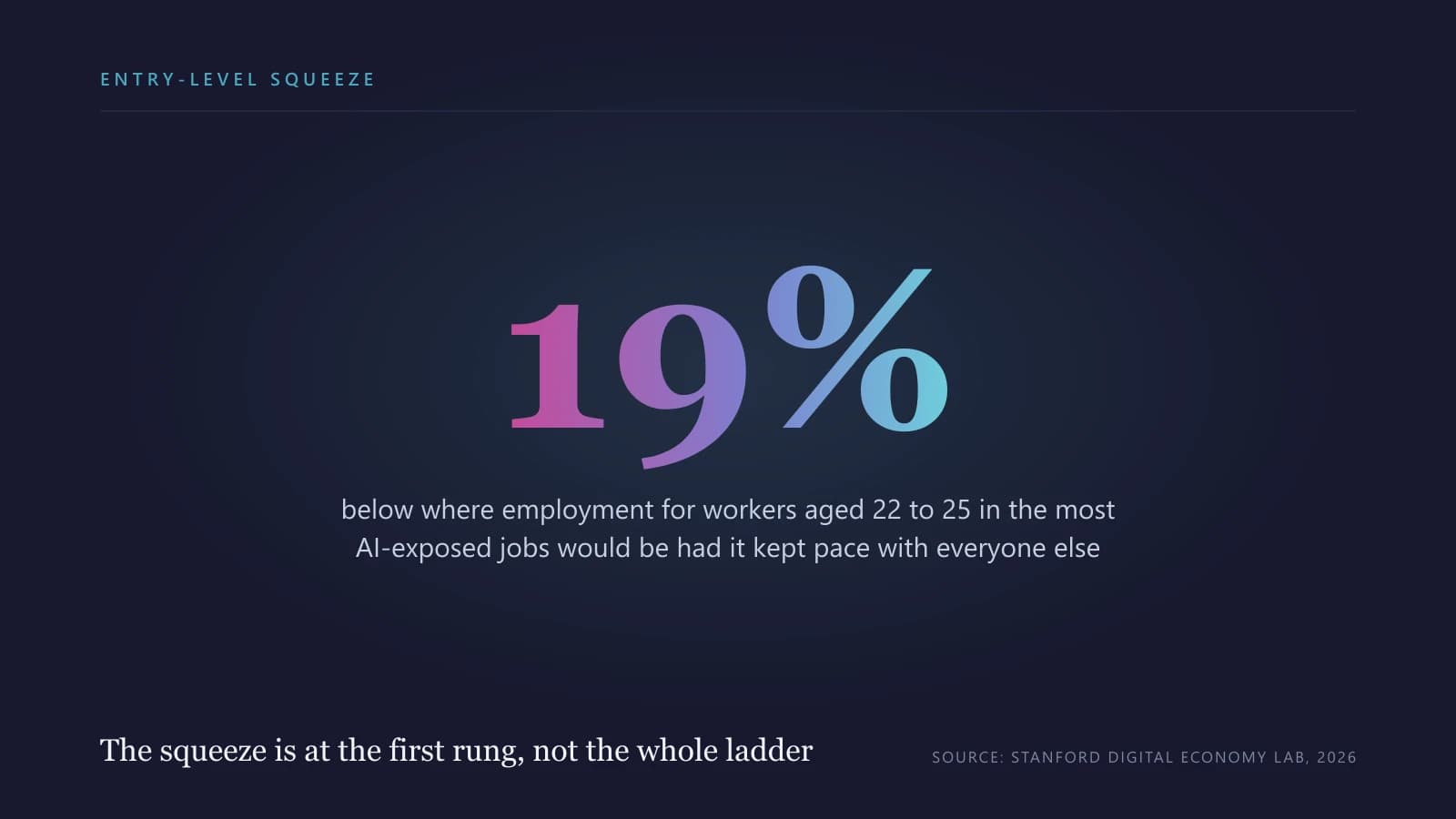
Here is the finding. Workers aged 22 to 25 in the occupations most exposed to AI are now employed at a rate about 19 percent below where they would be if they had kept pace with their less exposed peers. Experienced workers in the very same occupations show no such gap.
Not a recession. Not a wave of layoffs. One age bracket, in one set of jobs, quietly not getting hired.
The part that changes what you do about it
Two details in that research matter more than the headline number, and both get skipped in the coverage.
The first is the mechanism. The decline is happening through reduced hiring, not increased separations. Nobody is being marched out. The openings simply stopped appearing. That is a much quieter event, and it is why it took a payroll dataset to see it at all: a hiring freeze produces no news story, no severance, no one to interview.
The second is the condition. Employment fell in occupations where AI usage substitutes for human tasks. Where it complements the work instead, employment was flat or rising, especially for experienced workers.
Read that twice, because it is the whole ballgame. The variable is not whether your field is exposed to AI. It is whether, in your particular work, the machine replaces the step or speeds it up.
To their credit, the authors are careful about what they have. They call these early descriptive indicators, not causal estimates. The canary tells you the clock is running. It does not tell you what the gas is.
Now the inconvenient counterweight
If you stopped there you would conclude the economy is about to be rearranged. The most credible skeptic in the field says otherwise, and he is not a crank.
Daron Acemoglu shared the 2024 Nobel Prize in Economics for work on how technology reshapes wages and growth. His estimate is that AI will raise GDP by something like 1.1 to 1.6 percent in total over a decade. He puts the share of tasks that can be profitably automated in that window at roughly 5 percent. Around 20 percent are technically exposed, but only about a quarter of those are worth doing by machine once you count what it costs to actually deploy (MIT Sloan).
Goldman Sachs has published something closer to 7 percent. McKinsey has published numbers in the trillions. Acemoglu thinks they are all high.
So one body of evidence says something real is already happening to young workers, and a Nobel laureate says the macroeconomic effect over ten years will be modest.
Most writing about this picks a side. I do not think you have to, and I think the refusal is the actually useful position.
Both are probably right, and that is the forecast
A technology can have a small effect on total output and a savage effect on one specific group. Those are not contradictory claims. They are different questions.
Put them together and the ten year picture looks like this: the building is not coming down, but the bridge people used to walk in on is being taken apart while they are queuing for it.
The entry level job was never really about the tasks. It was a subsidy. A company paid a junior slightly more than they were immediately worth, absorbed their mistakes for a year or two, and got a mid-level employee at the end of it. That arrangement only ever made sense because there was no cheaper way to get the junior work done.
Now there often is. And the subsidy is the first thing to go, because it is the only part of the arrangement that was voluntary.
Nobody decided this. No executive announced it. It is the sum of a thousand hiring managers each deciding, reasonably, not to open one particular role this quarter.
The table nobody reads
Here is the second thing that gets lost, and it is the one I would most want a Filipino reader to sit with.
The World Economic Forum's Future of Jobs Report expects around 170 million new roles by 2030 against 92 million displaced, a net of about 78 million, with 39 percent of workers' core skills changing over the same period (World Economic Forum).
Everyone quotes the percentage table from that report. Big data specialists growing fastest, then fintech engineers, then AI and machine learning specialists. Every LinkedIn post you have seen is downstream of that one table.
Almost nobody quotes the other table. The roles growing most in absolute numbers, meaning actual human beings hired, are farmworkers, delivery drivers, construction workers, salespersons and food processing workers. Then nursing, social work, personal care, and secondary and tertiary teaching.
Not one of those is a tech job. All of them are jobs where the work happens in a body, in a place, with another person in front of you.
Percentage growth tells you where the leverage is. Absolute growth tells you where the jobs are. They are different tables and they answer different questions, and confusing them is how a person ends up doing a Python course for a market that was hiring nurses.
What a decade of automation actually looked like where I work
I work in manufacturing. My days are data analytics and data governance.
Manufacturing has been automating for forty years, so if you want to know what the next ten years feel like from inside, this is the closest thing we have to a rehearsal.
What I have seen is not the disappearance people expect. It is a migration. The task goes to the machine, the judgment stays with the person, and the job title survives while the content of it is quietly swapped out underneath. The line operator becomes the person who knows why the line stops. The clerk who typed the numbers becomes the person who notices when a number is wrong.
And the part that is genuinely lost is the bottom rung. The role that used to exist so somebody could learn the process by doing the boring version of it. That job goes, and the industry does not replace it with anything, and then five years later everyone is complaining that nobody knows how the process works.
That is the pattern I would expect to repeat across white collar work, and the Stanford data is early evidence it already is.
What I would put money on
I would rather give you probabilities than predictions. A ten year forecast stated with confidence is entertainment.
Things I would bet on:
- The entry level squeeze continues and spreads. It is already visible in payroll data, the mechanism is a hiring decision rather than a firing decision, and hiring decisions are easy to keep making.
- Experience gets repriced upward. If juniors are cheaper to skip, the people who already have judgment become more valuable, not less. This is the most under-discussed implication in the whole debate.
- The macro numbers stay unimpressive. Acemoglu is more likely right than the trillion dollar forecasts, mostly because deploying anything inside a real organization is slower and stupider than a demo suggests. Anyone who has tried to change one report in a company already knows this.
- Physical and care work grows, and stays underrated. The absolute numbers are not close, and nothing about a language model touches a hospital ward or a construction site.
- Hybrid roles win. Not the person who knows AI. The person who knows a domain and uses AI inside it. Domain plus tool beats tool alone, every time, in every technology shift I can find.
Things I would not bet on:
- Mass unemployment. No serious dataset shows it and the most careful economist in the field expects a modest aggregate effect.
- A safe job. Thirty nine percent of core skills changing by 2030 does not leave a hiding place. The question is not whether your work changes, it is whether you are the one changing it.
- Any specific date. Everyone who has named a year for this has been wrong so far, in both directions.
The one question worth asking about your own work
Forget the job title. The Stanford result points at something much more personal.
Take the thing you actually do all week and split it in two. On one side, the parts where AI would replace the step. On the other, the parts where AI would make you faster at a step only you can take, because it needs context, or a relationship, or someone willing to be accountable for the answer.
The first list is your exposure. The second list is your career.
Most people do this exercise and find the second list is thinner than they assumed, and that most of it is judgment rather than execution. Deciding what to measure. Noticing that a number is wrong. Telling somebody something they do not want to hear, and being right. Knowing which question is actually being asked.
None of that is a tool you install. All of it is built by doing the work with a person who will tell you when you are wrong, which is precisely the thing the vanishing entry level job used to provide.
That is the gap I would be worrying about if I were starting now. Not the robots. The missing apprenticeship.
What I would actually do
If you are early, stop optimizing for a first job that is disappearing and start building the evidence that lets you skip it. A portfolio of real work does what a junior year used to do: it proves you can be trusted with a decision. Build things nobody asked for, on messy data, with a conclusion at the end.
If you are experienced, understand that you are the scarce input now and price yourself accordingly. Then teach somebody, because the apprenticeship gap is going to become an industry problem and the people who solved it early will be the ones who kept training juniors when it was not obviously rational.
If you are choosing a field, read the absolute table, not just the percentage one. The Philippines will need nurses and teachers and skilled trades in numbers that no AI roadmap will change. There is no shame in the growing thing.
And if you are somewhere in the middle, which is most of us, the honest answer is that ten years is long enough for the picture to change twice. What survives that is not a tool you learned. It is the habit of noticing when the ground moves, and being willing to move first.
The canary is singing. That is not a reason to panic. It is a reason to look at where you are standing.
- #AI for Work
- #Future of Work
- #Career Growth
- #Philippines
Frequently asked questions
The evidence does not support it. Stanford's payroll analysis finds no economy-wide displacement, and Nobel laureate Daron Acemoglu estimates AI will raise GDP by only 1.1 to 1.6 percent over a decade, with roughly 5 percent of tasks profitably automatable. The measurable damage is concentrated, not general: entry level hiring in AI-exposed occupations.
Less useful than the real question, which is whether AI substitutes for your tasks or complements them. Stanford found employment fell only where AI usage replaced human tasks, and was flat or rising where it complemented them. Split your own week into steps AI would replace and steps it would merely speed up. The first list is your exposure.
It depends which table you read. In percentage terms the World Economic Forum puts big data specialists, fintech engineers and AI specialists first. In absolute numbers, meaning actual people hired, the biggest growth is in farmworkers, delivery drivers, construction workers, salespersons, nursing, personal care and teaching. Percentage growth shows leverage; absolute growth shows where the jobs are.
Build the evidence that lets you skip the vanishing first rung. A portfolio of real work on messy data, with a decision at the end, does what a junior year used to do: it shows you can be trusted with judgment. The scarce thing is no longer tool knowledge, it is the apprenticeship that used to turn a beginner into someone with judgment.