

AI for Work
The Sea and the Well
By JC de las Alas, Founder and Lead Instructor
· 11 min read
Beverly Morris is seventy-one years old, and she is afraid of her own kitchen tap.
She is a retired payroll specialist. She and her husband Jeff live in Newton County, Georgia, in a house that runs on well water, the way a lot of rural American homes do. In 2018, Meta broke ground on a 750 million dollar data center about a thousand feet from their property line. Within months, things in the house started failing. The dishwasher. The ice maker. The washing machine. The toilet.
Jeff eventually worked out what they had in common. Sediment. Grit was building up in their water, and it was killing the appliances one at a time.
Years later, two of their bathroom taps still do not work. They have spent five thousand dollars chasing the problem. Replacing the well outright would cost twenty-five thousand, which they do not have.
"I'm scared to drink our own water," she told the BBC (BBC News). And elsewhere, the line that has stayed with me since I read it: "It feels like we're fighting an unwinnable battle that we didn't sign up for" (Futurism).
The part that makes it complicated
Here is where most people writing about this reach for the obvious ending, and here is where I am going to disappoint you, because the obvious ending is not supported.
Meta commissioned an independent groundwater study of the Morris property. That study concluded the company's construction and operations were unlikely to have affected the well, pointing to the watershed structure, the topography, and the way groundwater actually flows in that area. Meta denies responsibility (Press Democrat).
So what do we have? A woman whose water went bad shortly after heavy construction started a thousand feet away, and a study saying that construction probably was not the cause. Both of those things can sit on the table at the same time. Neither one erases the other.
I spend my working life in data governance, which is a fancy way of saying I spend it arguing about whether a number means what somebody claims it means. And what strikes me about this story is not the villain, because I cannot prove there is one. It is the asymmetry.
On one side is a company that can commission a hydrogeological study. On the other is a retired couple with a broken toilet and a five thousand dollar hole in their savings, trying to establish causation in groundwater, which is genuinely one of the hardest things in environmental science to prove. Even if Meta is completely right, the Morrises still cannot drink their water, and nobody is coming to fix it.
That gap, between what is true and what an ordinary person can demonstrate is true, is the thing I want you to carry through the rest of this article. It comes back.
The context is not nothing either. Newton County is projected to hit a water deficit by 2030, with rates expected to climb by about a third, and the Meta facility accounts for roughly ten percent of the county's daily water use.
Now the other story, because it is a beautiful one
In 2018, in almost the same window that construction started in Georgia, Microsoft did something that sounds like science fiction and was not.
They sealed 855 servers inside a steel cylinder, filled it with nitrogen instead of air, loaded it onto a vessel, and sank it to the seabed off the Orkney Islands in Scotland. Then they left it there. No technicians. No swapping out failed drives. No opening it up to see how things were going. For two years.
The project was called Natick, and the logic behind it is the kind of thing an engineer falls in love with. Half the world's population lives near a coast, so put the compute near them. Seawater is cold and, crucially, its temperature barely moves, so the ocean does your cooling for free. Nobody can walk into a sealed capsule on the seabed and knock a cable loose. And if you fill it with inert nitrogen instead of oxygen and humidity, the components inside stop corroding.
In 2020, they pulled it back up.
Of the 855 servers, six had failed. The identical control group sitting on dry land had eight failures out of a far smaller population. Microsoft's own summary of it was that the underwater servers had roughly one eighth the failure rate of the equivalent machines on land (Tom's Hardware).
Read that again. They dropped a data center in the sea, ignored it for two years, and it was eight times more reliable than the one they were babysitting.
And then they shelved it
This is the part I find most instructive, and it is the reason I picked this story instead of a tidier one.
Microsoft did not continue with Natick. The project was wound down, and the company redirected its attention toward the enormous build-out that AI demand now requires (Data Center Dynamics).
The experiment did not fail. That is what makes it worth telling. It succeeded, on its own terms, in a way almost nobody predicted, and it still did not become the future. Because being more reliable is not the only question. There is also: can you build hundreds of these, quickly, near the grid connections and fiber routes you need, and service them at the scale the market is demanding right now? For a company being asked to add capacity faster than it has ever added anything, an elegant sealed tube on the ocean floor is a wonderful proof and an awkward answer.
The lesson generalises well beyond data centers, and I say this as someone who has watched good ideas lose to boring ones inside big organizations. Better rarely wins on its own. Better plus deployable wins. Anyone who has tried to get a superior process adopted at work already knows this in their bones.
The unglamorous version, and a confession
If sinking servers in the North Sea is the romantic answer, there is a duller one that actually scaled, and I have to declare an interest before I describe it.
I work at Schneider Electric, as a data governance manager. So weigh this section accordingly. Everything in it is published and externally verifiable, and none of it comes from anything I know internally. I would rather you read this skeptically than warmly.
Schneider has been named the world's most sustainable company by TIME and Statista three years running, most recently in 2026, after scoring 88.86 out of 100 in 2024 (The Manufacturer, Business Wire).
Treat the ranking the way you should treat any ranking. TIME and Statista begin with a pool of over five thousand large companies, run a four-stage screen, weigh external ratings and reporting practices and environmental and social indicators, and publish five hundred names. It is a serious measure of disclosure and performance among big listed firms. It is not a measurement of total planetary impact, and first place is not a moral fact.
What is actually interesting is structural. Schneider sells the efficiency layer inside the building: the uninterruptible power supplies, the cooling, the software watching all of it. Its data center segment grew around ten percent organically in 2025 (Data Centre Magazine). Which means its revenue goes up when its customers burn less power per unit of output.
That is the tell worth learning. Not the award. When a company profits specifically from its customers wasting less, efficiency stops being a press release and becomes the business model. When it does not, you are relying on goodwill, and goodwill is not an engineering control.
What all three stories are really about
Underneath Georgia, Orkney, and the trophy is the same physical fact.
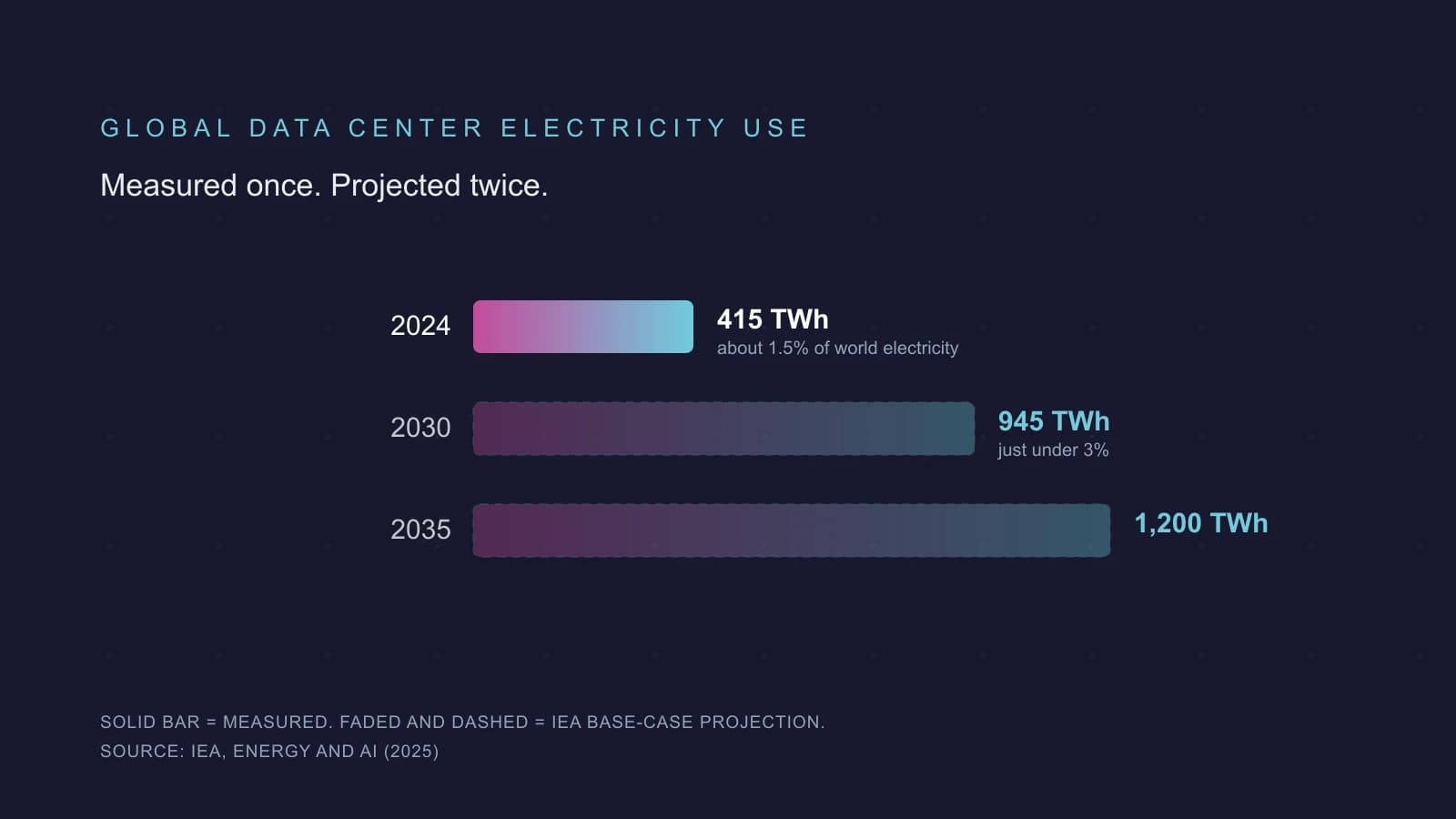
The International Energy Agency put global data center electricity use at roughly 415 terawatt hours in 2024, about 1.5 percent of the world's electricity. Its base case has that roughly doubling to around 945 TWh by 2030 and reaching about 1,200 TWh by 2035 (IEA, Energy and AI, 2025).
Notice something about those three numbers, because it is the same lesson as the Morris well. Only the first one is a measurement. The other two are projections from a base case, and they get quoted in the same breath, in the same font, as though all three already happened. The chart at the top of this piece draws them differently on purpose: solid for measured, faded and dashed for forecast.
And a data center is not an exotic object once you see through the word cloud. It is a factory. Its product is compute. Its raw materials are electricity, water, and land. It runs three shifts forever and its business model collapses the second it stops. The industry even has its own version of the manufacturing efficiency metric: PUE, power usage effectiveness, total facility power divided by the power that actually reaches the computers. Learn that one ratio and most of the marketing in this sector stops working on you.
Two more figures that rarely appear in the announcements. First, once running, these facilities employ roughly 0.15 to 0.35 permanent staff per megawatt. Google's 500-megawatt campus in Kansas City is expected to produce about a thousand construction jobs and two hundred permanent ones (Data Center News). Enormous infrastructure, small employer. Both true at once.
Second, closer to home: in June the Department of Energy reported the average Philippine electricity price reached 12.43 pesos per kilowatt hour, passing Singapore to become the most expensive in Southeast Asia (BusinessWorld). The most power-hungry industry of the decade is arriving in the region's costliest power market. That is not a reason to refuse it. It is a reason to know exactly who pays.
The bigger board
There is a phrase strategic analysts have been using for the world order forming around control of semiconductors: Pax Silica. It deliberately echoes Pax Britannica and Pax Americana, trading naval dominance for the ability to design and fabricate advanced chips (Real Instituto Elcano, GIS Reports).
The stack it covers is enormous. Critical minerals. Energy. Fabrication and packaging. Compute. Frontier models. Software platforms. Subsea cables. Data centers. Logistics.
A data center is one tile in that mosaic, which is exactly why it is a bad place to stop thinking. Hosting compute is not the same as owning it. A building can sit on your soil, full of somebody else's servers, serving somebody else's users, and the question of whether your country captured anything depends entirely on which layer you actually participate in. I am going to spend the next few articles walking that whole stack, and where we genuinely sit in it.
Why I told you these two stories
Because they are the same story from opposite ends.
Natick is what happens when a very well resourced organization asks a careful question, runs a real experiment for two years, gets a clean result, and then makes a hard-nosed decision about it anyway. Evidence, gathered on purpose, acted on honestly.
Georgia is what happens to a seventy-one year old woman who needs to establish causation in groundwater and has five thousand dollars and no laboratory. She may be right. She may be wrong. The study may be right. What is certain is that she was never equipped to find out, and the outcome of her life turned on evidence she could not produce.
That contrast is the entire argument for learning to work with data, and it is not an abstract one. The ability to ask what a number counts, where it came from, and who benefits if you believe it is not a technical hobby. In the Morris story it is the difference between being heard and being managed.
You will not get that from a data center. Two hundred permanent jobs on a 500 megawatt campus are real careers, and they are mostly specialized facilities and electrical work. That door is narrow. The wide door is the layer above: the analytics, the cloud work, the automation, the AI work that exists because compute got cheap and close. That is where somebody self-taught with a portfolio can genuinely compete.
Beverly Morris did not need a data center. She needed one person on her side who could read the study, find its assumptions, and ask the right question out loud.
That job is open, everywhere, and it does not require anyone's permission to start.
If you want to practice it, the free resources here are built for exactly that: messy real datasets and scored judgment calls instead of tidy textbook examples. Take whichever one looks least comfortable.
- #Data Centers
- #AI Infrastructure
- #Philippines
- #AI for Work