

Upskilling
In-Demand Skills to Learn in the Philippines to Earn More in 2026
By JC de las Alas, Founder and Lead Instructor
· 8 min read
Every year the "skills of the future" lists come out, and most are useless because they are too vague. "Critical thinking" does not pay your Meralco bill. So here is a more grounded question: what specific skills are Filipino employers, clients, and businesses actually paying for in 2026, and how do you start learning them without quitting your job or draining your savings?
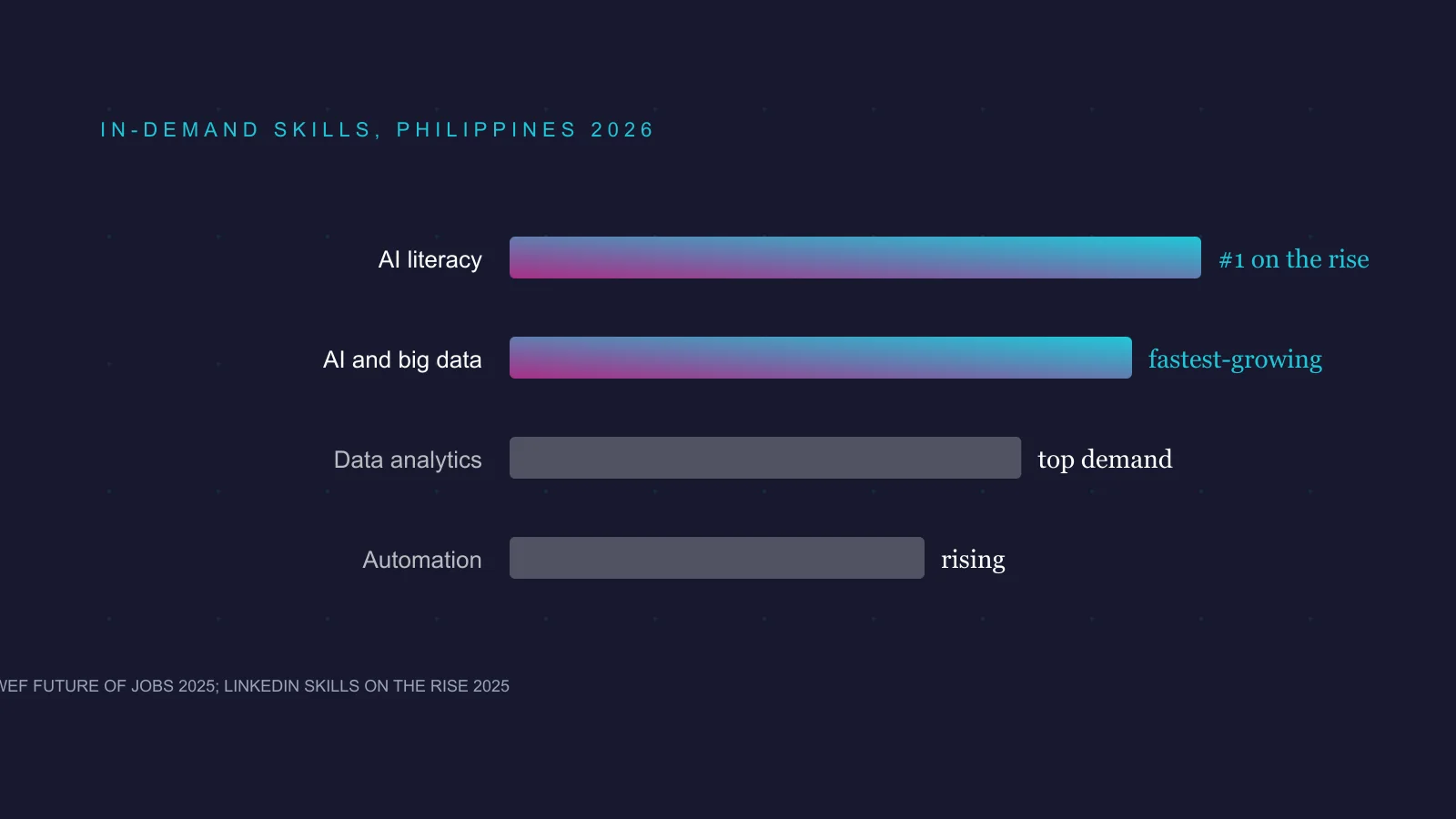
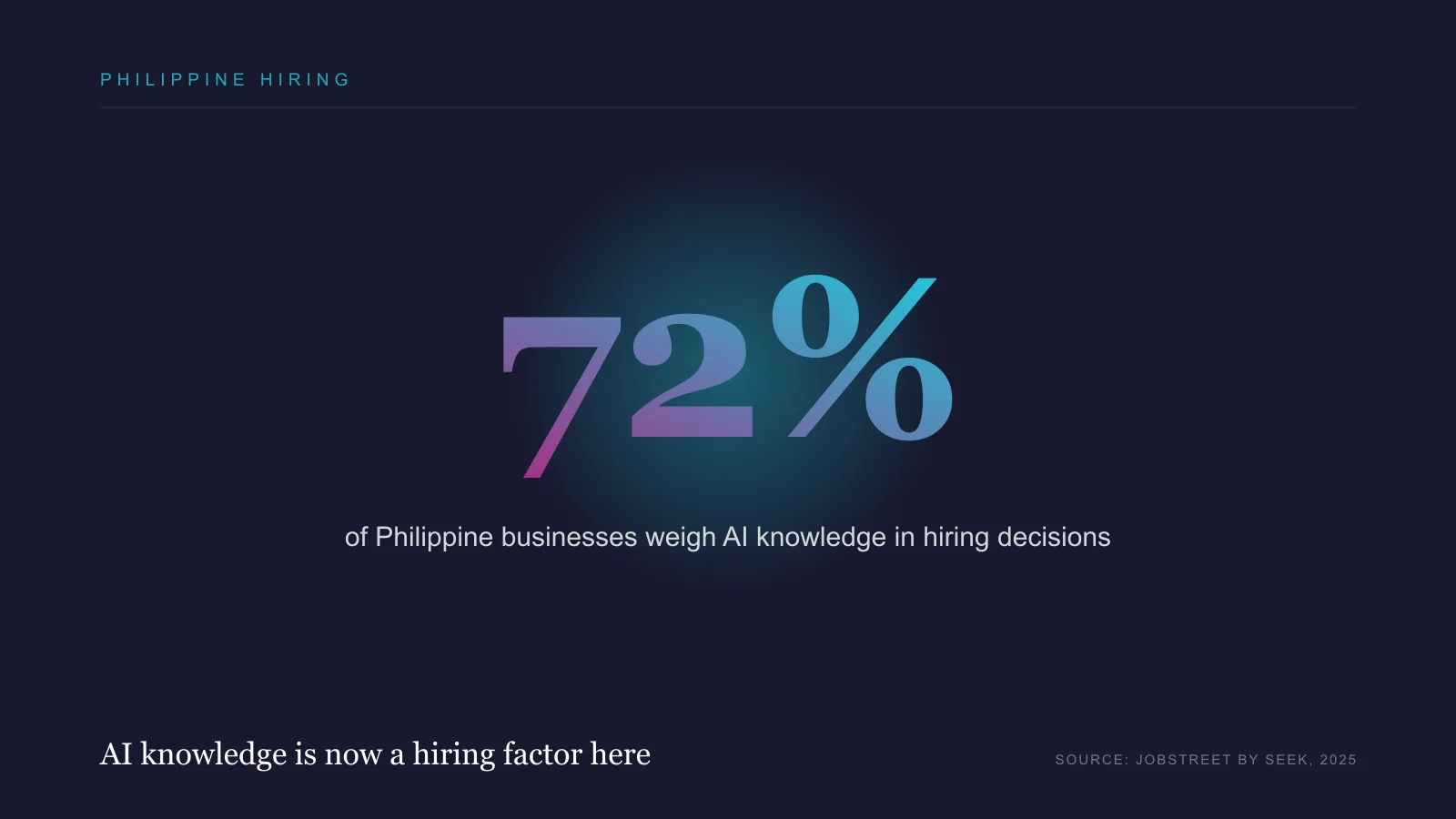
The macro trend is real, not hype. The World Economic Forum's Future of Jobs Report 2025 projects 170 million new roles this decade and names AI, big data, and analytics among the fastest-growing skills, with more than 90 percent of employers expecting demand for them to rise. Closer to home, a Jobstreet by SEEK survey found that 72 percent of Philippine businesses now weigh AI knowledge in hiring decisions. Below are the skills with the clearest path from "I am learning this" to "I got paid for this," roughly in the order a beginner can turn them into income.
1. Using AI tools well (ChatGPT, Claude, and friends)
This is the fastest upskill with the widest payoff. The people getting ahead are not the ones who fear AI, they are the ones who use it to do a day's work in an hour: drafting reports, cleaning data, writing emails, summarizing documents, brainstorming. You do not need to be technical. You need to know how to prompt well and when to trust the output. It shows up in the data too: LinkedIn ranked AI literacy the number one skill on the rise for professionals. Real scenario: a virtual assistant who learns to draft client reports with AI can take on twice the clients in the same hours.
Where to start: our AI bootcamp teaches ChatGPT and Claude for real work, and the free resources include AI cheat sheets you can use today.
2. Data analytics (Excel, SQL, Power BI, Tableau)
Every business runs on numbers, and most are drowning in spreadsheets no one has time to make sense of. An analyst who can turn a messy export into a clear dashboard is valuable in a BPO, a bank, an NGO, or a retail chain. The tools are learnable in weeks, not years: Excel for the foundations, SQL to pull data, Power BI or Tableau to make it visual. Here is how to become a data analyst with no experience.
Where to start: try a free practice project with a real messy dataset, then read our guides on Excel and SQL.
3. Automation and no-code building
Connecting apps so work happens by itself is a quiet superpower. Auto-send a receipt when someone pays, sync leads from a form into a CRM, generate a weekly report without touching it. Business owners pay well for this because it saves them hours every week. You do not need to be a developer; you need to understand workflows and a few tools.
4. Building a personal website or simple app
Being able to put something online, a portfolio, a landing page, a small app, turns you from "someone who took a course" into "someone who ships." It is also the single best proof of skill you can show a client. With AI-assisted building, this is far more approachable than it was even two years ago.
5. Digital and personal branding
Skills get you the work; visibility gets you found. Learning to present yourself online, a clean profile, a portfolio, a simple content habit, is what turns a hidden skill into inbound opportunities. This is especially powerful for freelancers and virtual assistants competing for international clients.
A second opinion worth watching
You do not have to trust one source. Cambridge-trained doctor turned educator Ali Abdaal reaches millions with the same core message the WEF and LinkedIn data show: the skills that pay are learnable, and most of them now compound with AI. His breakdown of high-income skills to learn is a useful cross-check on the list above.
How to actually learn these without burning out
You do not need to learn all five at once. Pick one, ideally AI tools or data analytics, because they compound with everything else. Give it focused practice on real scenarios, not passive tutorials. Build one small thing you can show. Then stack the next skill on top. A career shifter who learns data analytics, then adds AI and automation, becomes far more valuable than someone with one skill alone.
The AI-Powered Data Analytics Career Bootcamp was designed to stack exactly these: AI tools, data analytics, automation, and personal branding, in one beginner-friendly path with live sessions and a portfolio at the end. Learning while working full-time? See how to upskill without quitting your job, or start with the free class.
- #Upskilling
- #In-Demand Skills
- #AI for Work
- #Career Growth
Frequently asked questions
The ability to use AI tools like ChatGPT and Claude well is the fastest, most widely useful skill, closely followed by data analytics with Excel, SQL, and Power BI. Both turn into income quickly because nearly every business needs them, and both are learnable by beginners in weeks.
Data analytics, AI-assisted work, automation, and digital or personal branding are all remote-friendly and in demand from local and international clients. Virtual assistants who add data or AI skills can command higher rates and take on more work in the same hours.
No. The most in-demand skills here start from computer literate, not computer science. Data analytics and AI tools in particular are designed to be beginner-friendly, and a portfolio of real work matters more to employers than a specific degree.
With focused practice on realistic projects, many beginners reach a usable, income-ready level in a few weeks to a couple of months per skill. The fastest path is building real outputs and getting feedback, rather than passively watching tutorials.