

AI for Work
Companies Raced to Replace Workers With AI. Watch What the Smart Ones Did Next.
By JC de las Alas, Founder and Lead Instructor
· 8 min read
In early 2024, Klarna made an announcement that rippled through every boardroom: its new AI assistant was doing the work of 700 full-time customer service agents, handling two-thirds of its chats in the first month (Klarna). The message the world heard was simpler and scarier: the robots are here, and they are cheaper than you.
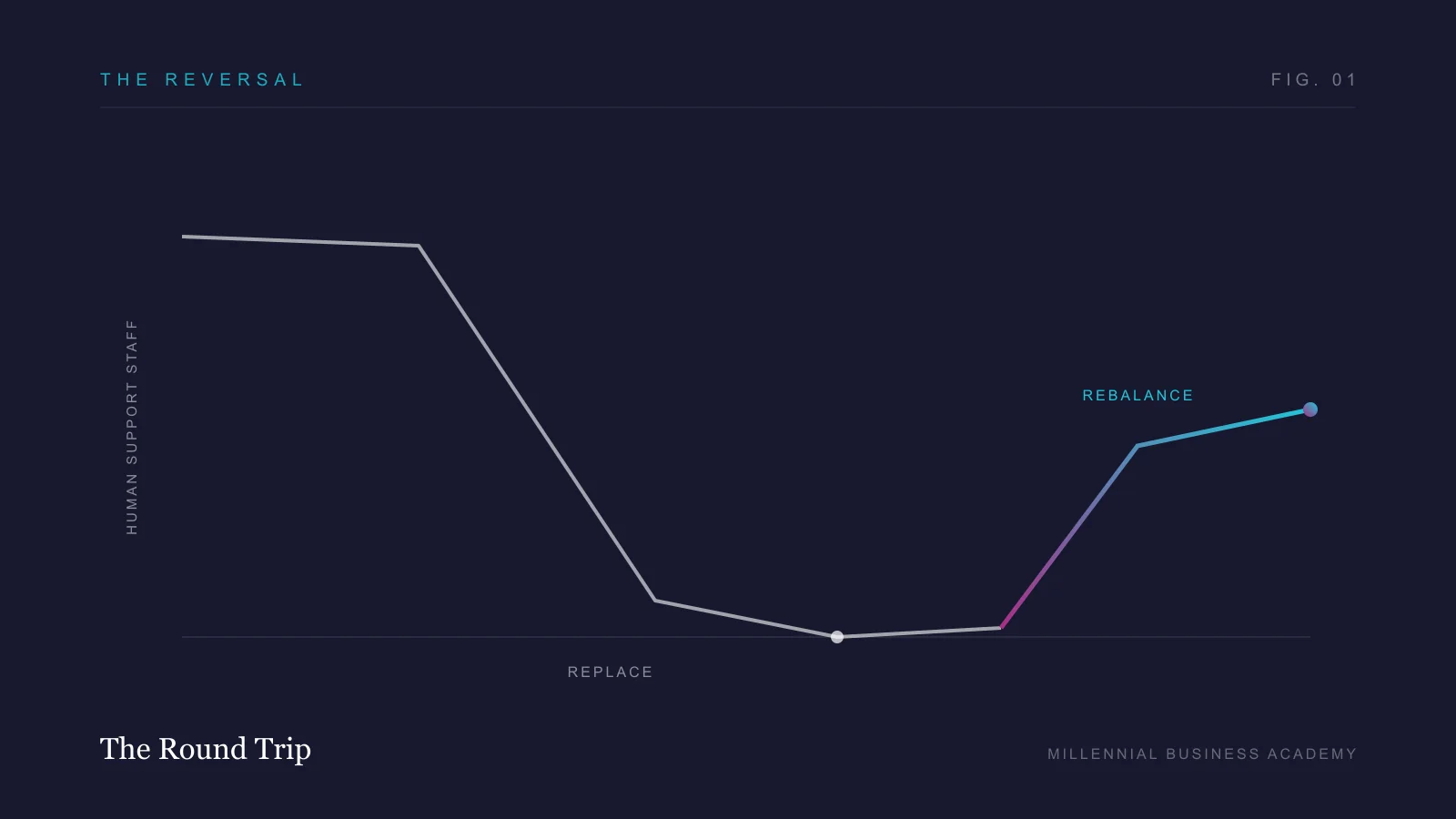
Then something quieter happened. A year later, Klarna's CEO admitted the company had leaned too hard on AI at the expense of quality, and began hiring humans back for customer service (Fortune). "We went too far," he said.
That round trip, replace and then rebalance, is the real story of AI and work right now. It is more hopeful than the headlines, and it asks something specific of you.
What the companies actually said
The pressure is real, and it is worth being honest about it. Shopify's CEO told staff, in a memo he later posted publicly, that using AI is now "a fundamental expectation," and that teams must prove a job cannot be done by AI before asking for more people (CNBC). Duolingo declared itself "AI-first" and said it would gradually stop using contractors for work AI can handle (Fortune). Back in 2023, IBM's CEO said the company would pause hiring for back-office roles it expected AI and automation to handle over several years (Fortune).
Read those quickly and it sounds like a countdown. Read them carefully and you notice something else: every one of them is really a demand for a new kind of worker, the person who wields AI, not the person who competes with it.
Then came the plot twist
The companies that swung hardest toward pure automation kept hitting the same wall: quality. Klarna rebalanced back toward humans. After a public backlash, Duolingo's CEO clarified that AI was "not replacing" employees and that hiring continued, later admitting the original memo "did not give enough context" (TechCrunch).
The pattern is not "AI does the job." It is "AI plus a skilled human does the job better than either alone, and companies keep learning that the hard way." The winners were not the people the AI displaced, and not the executives who over-promised. They were the workers who learned to run the machine.
What the data actually says
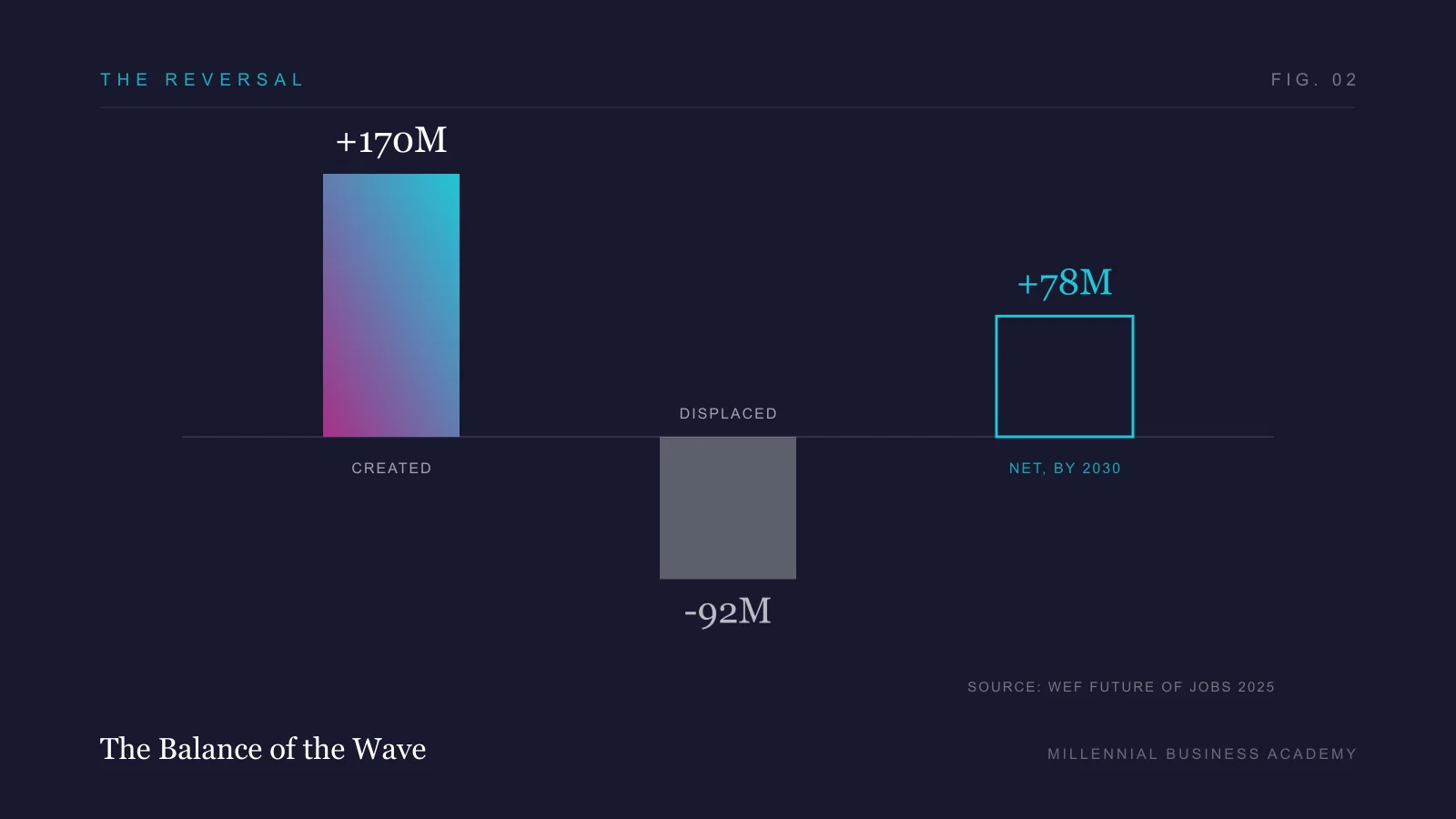
Step back from the headlines and the numbers are far less apocalyptic than the mood. The World Economic Forum's 2025 Future of Jobs report projects that by 2030, technology will displace 92 million jobs but create 170 million new ones, a net gain of 78 million (World Economic Forum).
The word that keeps getting lost is "exposed." Goldman Sachs' widely quoted estimate that generative AI could affect 300 million jobs is about exposure to automation, not elimination (CNBC). The IMF, warning that roughly 40 percent of jobs worldwide are exposed, is careful to add that about half of those could be helped by AI rather than hurt (IMF). And the International Labour Organization concluded that generative AI is more likely to augment jobs than to destroy them outright (ILO).
Exposed is not erased. The honest risk is not mass unemployment. It is a widening gap between the people who use these tools and the people who do not.
History keeps trying to tell us this
We have been here before, and the most famous example is the one almost everyone gets wrong. When ATMs spread across banks in the 1970s and 80s, the obvious prediction was that human tellers were finished. The opposite happened.
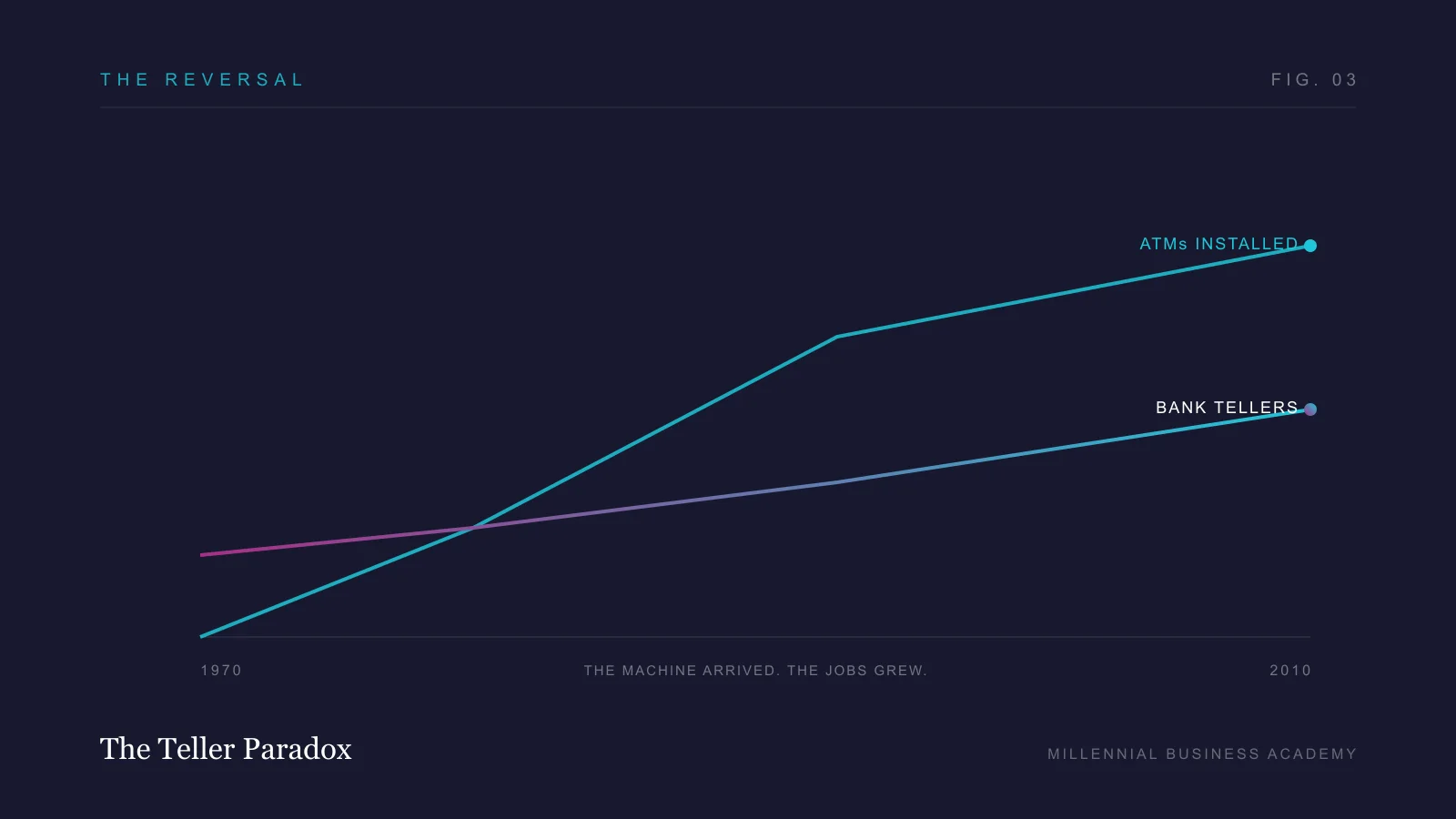
The economist James Bessen documented that ATMs cut the number of tellers per branch, but by making branches cheaper to run, they let banks open many more branches. The total number of tellers actually rose, and the job shifted from counting cash to helping customers (American Enterprise Institute). The machine did not kill the job. It changed what the job was, and rewarded the people who adapted.
So what do you actually do
Not panic, and not gatekeep. Here is the honest playbook.
- Become the person who runs the machine. The safest role in every one of these stories is the human who uses AI fluently: someone who can prompt it, check its output, and do in an hour what used to take a day.
- Move up the ladder the tools build. When AI handles the routine, the valuable work becomes judgment, taste, relationships, and knowing which questions to ask. Aim there.
- Use it to become capable, not to fake it. AI can do your thinking for you, and that is the one trap that will quietly hurt you. Use it to understand faster, then stand on your own.
- Lift as you climb. Teach what you learn to your team, your family, your barangay. In a world where skills are the new capital, generosity is how a whole community rises, not just one lucky person.
If you want a concrete start, learn the tools employers are actually asking for: the in-demand skills for 2026, or the path to becoming a data analyst with no experience.
The quiet good news
The scary version of this story, where AI simply erases the workers, keeps failing to come true. What keeps happening instead is messier and more human: the tools get powerful, the routine gets automated, and the people who learn to wield them move up while the people who wait get left behind. That is not fate. It is a choice, and for once it is a choice almost anyone can afford to make.
That is the whole reason Millennial Business Academy exists: to put these tools in the hands of Filipinos who were never first in line, plainly and affordably. If you want a place to begin, start with the free training, and bring someone with you.
- #AI for Work
- #Future of Work
- #Upskilling
- #Opinion
Frequently asked questions
The evidence points to disruption, not mass replacement. The World Economic Forum projects a net gain of 78 million jobs by 2030, and bodies like the IMF and ILO stress that many exposed jobs will be changed or even helped by AI rather than eliminated. The bigger risk is a widening gap between workers who use AI well and those who do not.
Klarna publicly said in 2025 that it had leaned too far into AI at the cost of service quality and began hiring humans back for customer support, moving to a hybrid model. Duolingo's CEO also clarified that its AI-first memo did not mean replacing employees. The emerging pattern is human-plus-AI, not human-versus-AI.
Become the person who uses AI fluently in your field, and move toward work that needs judgment, creativity, and relationships. Learn to prompt well, check AI output, and apply it to real tasks. Those skills are in demand across almost every industry.
Start free: use tools like ChatGPT or Claude to learn and practice on real tasks, then build in-demand skills like data analytics and automation through structured training. The goal is to become capable with AI, not merely aware of it.